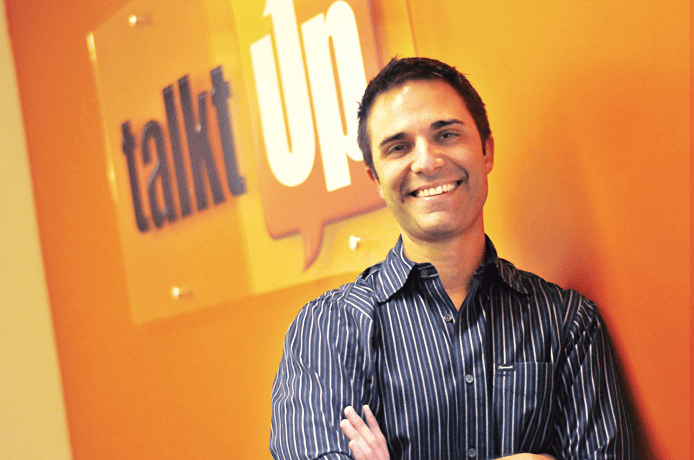
Building up local businesses, one smartphone at a time.
Aaron Goodin is no stranger to app technology – he helped design some of the first cell phone applications nearly a decade ago. Today, he is the CEO of talktUp, a social sharing app that is creating quite a stir in the wireless world. Along with co-founder/CFO Saif Hakim and the company’s creative team, Goodin hopes talktUp will create an unprecedented dynamic between local business owners and their faithful customers.
How long have you been involved in software technology design?
About 13 years. I graduated pre-vet and went to vet school in Liverpool. I came back and jumped into the dot-com business in 1999. After the crash, two partners and I started a technology consulting company. Eventually, we got into Microsoft and we were doing development for the Windows mobile devices. Microsoft would give us their new phones, and we’d pre-load them with accounts, email, apps, etc. Then, they would do seed launches to Hollywood stars or various CEOs with the pre-loaded phones. We built a sports ticker app that went across the phone’s screen. Now, this is back in 2002-03. We were ahead of everything, and it was really fun.
In your opinion, how has app technology changed since then?
Well, back then, people didn’t really know what we had. I’d go around and show people what we were building, and they thought I was a wizard. Or if I put a movie on my phone, they thought it was cool but they didn’t understand the power of what was possible. And back then, apps were just tools – sports tickers, email, etc. It had nothing to do with ‘social’ or ‘local’. But now, people live their lives by the apps on their phone, and there’s an app for just about everything.
After you left your gig at Microsoft, what came next?
I sold my company in 2004, and was running the network for a local mortgage company. I did that, but I was bored after about a year, so I started doing loans. And then, the mortgage crash happened. The thing I liked about mortgages back in the heyday was that I was helping people buy their first home, or if they were in credit trouble, we could refinance and help them. Then it turned into, “you don’t qualify”. Or, “you think your home is worth this, but after the crash it’s actually worth that”. Everything was negative. So, in Spring 2010, I’d had enough and quit.
Where did the idea for talktUp originate?
talktUp is something I had in the back of my mind for a long time. I’m a promoter and a researcher. If I want to buy a pair of hiking shoes, or a new car or phone, I’ll research the heck out of them. Once I buy it, I’ll talk about it to everybody. When I was in college, I bought a pair of Adidas hiking boots. By the time I was done, four of my friends had bought them.
When the economy crashed, there was a rise in ‘daily deals’. All these businesses were suffering, and they would offer a daily deal to get an influx of people walking through the door. We knew business owners, restaurant owners or otherwise, who tried a daily deal offer (Groupon, Livingsocial, etc.), but their business ended up suffering due to deep discounting.
We know a couple of restaurant owners down in Portland who did a daily deal. They cut their product 75 percent to get people in the door. Well, unfortunately for them, the deal company oversold how many deals they were going to do. On top of that, the owners had a death in the family on the East Coast. This is a ma-and-pa shop, so they had to close for a couple of days and fly over for the funeral. Then, all these coupon holders came flooding in and it was closed, so they wrote all these scathing reviews. It just killed their business.
So we thought, there has to be a better way. With today’s social media technology, the reach of customers can be anywhere from a dozen people to hundreds or thousands. We thought, why can’t you leverage the customers you already have and their networks to bring in other people? So, we came up with a way to track word-of-mouth, because if we can track it, we can reward it. We offer that to the businesses, and they have a better way to drive business – at the fraction of the cost of doing a daily deal.
The talktup app is currently in the beta-testing stages. When will it be available to smartphone users?
We started the test in late June, and it wrapped in mid-October. The V1 app is currently available for download on the iTunes store. We’ve taken everything we learned from our beta, and expect to re-launch V2 in late January.
 What can users expect from the ‘talktup experience’?
Right now with other apps, people are always ‘checking in’. talktUp is a little different; you just share your favorite businesses with your friends by ‘talking them up’. If you visit a place and really like it, you can post that on Facebook or Twitter, or send it directly to somebody. By doing, people can click the links and you start building a following for that place. You’ll have your own brand of places you talk up, whether they’re salons or car maintenance places or restaurants and bars. You have a following for each one; you might have 10 people following one place, and two people following another.
Once you have a following, you can track your rewards. In the next phase, businesses will be able to ‘talk back’ by sending information about events or promotions directly to their talktUp followers. Users can also send an anonymous comment card to business owners.
What devices are compatible with talktUp?
We originally launched with iOS Native (for the iPhone), but we have a web app that works on Android.
Let’s say I’m a talktUp wizard. How much money could I potentially earn by recommending establishments to my ‘crew’?
Let’s say the user is an introvert. He has four followers, gets coffee at a coffee shop and has one bar he goes to every now and then. We had him earning $120 a month, but his spending over the month was more like $200. He doesn’t make money, but he earns money back on what he spends. Then you go to the other end with the socialite, who earns up to $300 per month.
Aside from the whole ‘getting paid’ aspect, how is talktUp different from other customer loyalty apps like Foursquare?
When we started, Foursquare was all about check-ins – it’s more about you and where you are. We wanted to help the businesses. But as we built it out, it became more about community and relationships with businesses. Yeah, you get kickbacks for what you’re doing, but really you are helping local businesses and building relationships.
How can business owners get involved with talktUp?
It’s simple. We have a business link on the website. They fill out a form, and then we contact them. We verify all their information – address, phone number, etc. – and they sign an open-ended agreement. It’s free for businesses to sign up, and there’s no integration or setup. We do everything on the back end. And any business can join. We have everything from gyms and auto shops to a flooring company.
How many businesses are currently on board?
At the end of the pilot program, we had 20-30 businesses signed up.
How has talktUp taken part in local philanthropic causes?
We wanted to help non-profits with talktUp. Our first non-profit partner is Food Lifeline. Every time a member spends $20 or more at a local business, we donate a meal to Food Lifeline. You are able to share how many meals you’ve donated.
When talktUp launches, the app will only cover establishments in the Pacific Northwest. Any plans to expand elsewhere?
The main staple will be Puget Sound area and Portland, but we have distribution partners in Chicago, New York and Phoenix. We have people signed up across the country. We’ll pick six cities, and we’re going to have a small foothold in those cities and people will have activities there. If all goes well, then we’ll go from there.
In your opinion, how has app technology transformed the way humans socialize with one another?
Well, they’ve changed the definition of what is means to be ‘social’. People can be sitting in the same room, texting one another. Or you’ll have people who are super-social on Facebook or Twitter, but when you put them in a social situation, they stand against the wall and don’t talk to anybody. As far as benefits to other businesses, people are constantly connected. I could be in a business right now, and hundreds of people will see it. And we have instant access to information and reviews. Before, I could find information using my computer. Now it’s in our pocket. Everything is moving faster.
talktUp is currently available for free download at the iTunes store. For more information about how the app works, please visit the official talktUp website.
 S E A T T L E I T E